Why Your Paycheck Disappears in 48 Hours (And How to Fix It)

Updated: Aug 19
Add your headline here
This is a placeholder paragraph. Replace this text with your own content.
Payday Isn't the Problem. The First 48 Hours Are.

Payday feels like relief. The account fills up, the anxiety drops, and for a few hours it looks like you're caught up. Then the money moves fast.
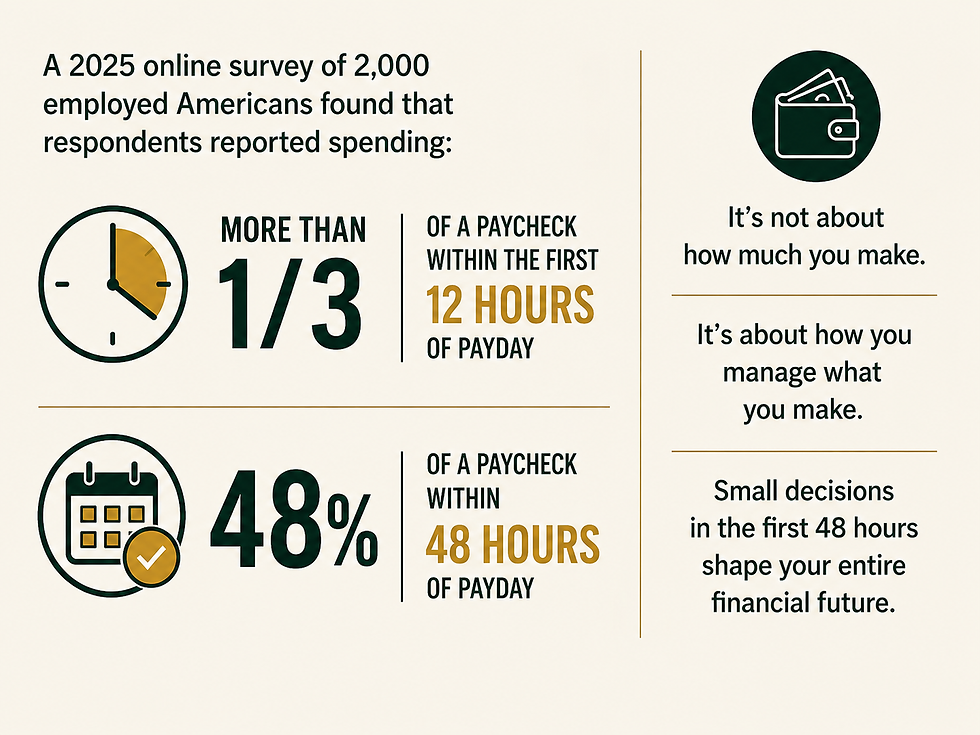
A 2025 online survey of 2,000 employed Americans found that respondents spent more than a third of their paycheck within the first 12 hours after it landed. By the 48-hour mark, 48% of the paycheck was gone. That's not a slow leak. That's a window, and it closes almost as fast as it opens.
The Real Problem Isn't Willpower
It's tempting to read those numbers and think people just need more discipline. The data doesn't support that story. In the same payday-spending survey, more than a third of respondents said they overspend in the days right after payday, not because they're chasing wants, but because rent, groceries, and overdue bills all land in that same window. Due dates cluster around payday because everyone plans around the same calendar. Landlords, utility companies, and lenders all know when you get paid, and they schedule accordingly.
So when your paycheck disappears in 48 hours, part of what's happening is math, not mindset. The bills were already waiting.
But Cost Isn't the Whole Story Either
Here's where I want to be careful. It would be easy to swing the other direction and say this is purely a cost-of-living problem, that income is the only lever that matters. The data doesn't fully support that either.
Bankrate's 2025 survey found that 27% of U.S. adults have no emergency savings at all, and only 41% said they'd cover a $1,000 surprise expense using savings. Separately, another 2025 survey found that 34% of Americans save none of their paycheck. Among adults ages 45 to 54, a group that's often past the early-career squeeze and further along in their earning years, 42% reported living paycheck to paycheck with no savings contribution at all.
If this were purely an income problem, we'd expect savings behavior to track more closely with age and earning potential. It doesn't move as cleanly as that. What's showing up instead is a timing problem layered on top of a cost problem. Obligations hit first. Whatever's left gets spent fast, whether or not there was room to save it.
That's the honest read: this is both an income-and-cost-of-living challenge and a cash-flow timing challenge. Neither one cancels out the other.
Why Timing Deserves Its Own Fix
Most financial advice treats savings as something you do with what's left over. Pay the bills, buy what you need, and whatever remains goes into savings, if anything does. The problem with that approach is that "what's left over" gets decided in the first 48 hours, often before you've had a chance to think it through.
By the time Sunday night rolls around and you sit down to budget, the decision has usually already been made for you. The money that was going to disappear into small purchases, catch-up spending, and clustered due dates is already gone. You're not budgeting anymore. You're doing an autopsy.
This is why the Foundation phase of the F.L.E.X. system starts with sequencing, not with cutting expenses. Before you optimize spending, you have to control the order money moves in. Whoever gets paid first, keeps the money. Right now, for most people, that's whoever they owe, not their own future.
The Move: Make Saving the First Transaction
The fix isn't complicated, even though it runs against how most people are wired to think about money. Set up an automatic transfer that pulls a set amount into savings the moment your paycheck lands, before you've had a chance to spend, before bills auto-draft, before the 48-hour window even opens.
This isn't about saving what's left. It's about deciding what's protected before the window closes. Even a modest amount, moved automatically and immediately, changes the sequence. It turns saving from a hope into a transaction that already happened.
You don't need willpower for a transfer that executes automatically. You need it set up once, and then you need to leave it alone.
The Bigger Point
Payday isn't broken. The sequence around it is. Bills and due dates are going to keep landing in that same window, and no amount of discipline changes when a rent payment is due. What you can change is whether your savings gets a seat at that table or gets left to compete with everything else for whatever's left.
Move first. Automate it. Let the rest of your money follow the plan you already made, not the one your bills made for you.
Ready to see where your money habits actually stand? Take the free Owner Mindset Assessment and find out which of the four archetypes describes how you handle money right now, and what it's costing you in the first 48 hours after every payday.


Comments